Gerbils may be small, but their personalities and abilities are anything but ordinary. These adorable, sand-loving rodents have been captivating pet owners and researchers for decades.
Whether you’re already a proud gerbil parent or simply curious about these tiny creatures, here are 12 interesting facts about gerbils that will surprise, entertain, and educate you.
Tiny Creatures, Big Surprises: The World of Gerbils Uncovered
Gerbils, often underestimated as simple, timid pets, are in reality tiny titans of the animal kingdom with astonishing adaptations and complex social lives.
Forget everything you thought you knew about these “desert rats”—these twelve facts will leave you in awe and secure their spot as one of the most fascinating small mammals on the planet.
Quick Facts About Gerbils
| Fact | Detail |
|---|---|
| Scientific Name | Meriones unguiculatus |
| Origin | Mongolia & Northern China |
| Lifespan | 3–5 years |
| Size | 4–5 inches (body) |
| Diet | Seeds, grains, fruits, veggies |
| Behavior | Social, curious, active |
| Unique Trait | Communicates by drumming its hind legs |
12 Unknown Facts About Gerbils
1. Thumping for Survival and Romance
Gerbils communicate with their feet! When they sense danger, they use their long hind legs to rapidly thump the ground, creating vibrations that warn the entire colony. Male gerbils also use a specific thumping rhythm as part of their courtship ritual—a noisy declaration of love!
Quick Fact: Gerbils earn the nickname “Clawed Warrior” because their scientific name, Meriones unguiculatus means “little clawed warrior,” reflecting their powerful digging claws and bold nature.
2. They Hardly Ever Urinate
An amazing adaptation to their arid desert homes: gerbils’ kidneys are exceptionally efficient. They can conserve water so effectively that they excrete extremely concentrated urine, producing very little liquid waste. This makes their enclosures significantly less smelly than those of many other rodents.
3. Their Tails Are Their Weak Point
A gerbil’s tail may look cute and fuzzy, but it’s actually very fragile. If it’s pulled too hard, the skin can slip off—a condition called degloving. This natural defense mechanism helps them escape predators, but it doesn’t grow back.
4. The Secret Scent-Marking Language
Gerbils communicate extensively using a language humans can’t hear or see: scent marking. They have a scent gland on their abdomen, which they deliberately rub on objects in their territory, like toys, tunnels, and tank corners, to leave behind a unique pheromone signature.
This tells other gerbils, “I live here,” “This belongs to me,” and even signals their social and reproductive status.
5. They Can Go Weeks Without Drinking Water
Because of their desert origins, gerbils have evolved to extract moisture from their food. In the wild, they can survive for weeks without directly drinking water—an adaptation few animals can match. That’s why they are known as “desert rats.”
6. Gerbils Love to Dig Complex Burrows
Digging is in their DNA! Gerbils create intricate tunnel systems with multiple entrances and rooms for nesting, storing food, and hiding. Gerbils are master engineers. A wild gerbil colony constructs elaborate, multi-chambered burrow systems that can plunge up to 1.7 meters (5.6 feet) deep and stretch horizontally across a massive 6-8 meters (20-26 feet)!
These intricate underground cities include dedicated areas for nesting, food storage (the “larder”), and even escape routes.
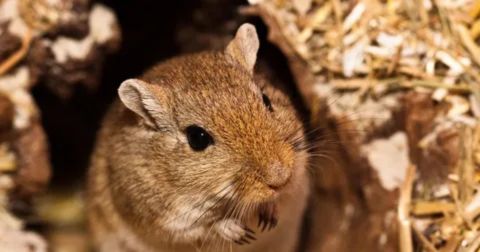
7. They Have Poor Eyesight But Great Smell
While gerbils don’t see well, their sense of smell is extraordinary. They use scent marking to recognize each other and navigate their environment—especially when underground.
8. Their Lifespan Is Longer Than You Think
While many small rodents live only a year or two, gerbils can live up to 4–5 years with proper care. That’s plenty of time to build a real bond with these tiny, energetic friends.
Quick Fact: Gerbils were first brought to the U.S. in 1954 by Dr. Victor Schwentker for medical research, not as pets—their gentle and social nature was discovered in labs, leading to their rise as beloved pets by 1964.
9. They Take Sand Baths, Not Water Baths
You should never bathe a gerbil in water. Adapted to dry climates, they keep their coats clean and healthy by rolling around in a special dust or chinchilla sand bath. This process removes excess oils and debris, maintaining their soft, desert-ready fur.
10. Devoted Fathers Who Raise the Pups
Unlike many other rodent species where the father is absent, male gerbils are active, involved parents. They gather nesting materials, clean the pups, and help teach them vital life skills. Studies show that pups raised with their fathers tend to be more active and develop faster.

11. Some Can Suffer from Epilepsy
A surprising number of gerbils, particularly the most common pet species (the Mongolian Gerbil), are prone to epileptic seizures. These seizures are often stress-induced, but most are mild, typically beginning in the first few months of life and decreasing in severity as the gerbil ages.
12. Gerbils Can Jump Up to 5X Their Own Height
Despite their small size, gerbils are incredible jumpers. They use their strong hind legs to leap nearly a foot in the air! This agility helps them escape predators and explore their environment when living in the wild—or even inside your living room.
Quick Fact: The common pet gerbil belongs to the Gerbillinae subfamily, which includes over 100 species—from the tiny Fat-tailed Gerbil to the giant Great Gerbil that can reach 16 inches long, including its tail.
FAQs
1. Are gerbils good pets for kids?
Yes! Gerbils are friendly, low-maintenance, and rarely bite, making them ideal pets for children under supervision.
2. Can gerbils live alone?
No, gerbils are social animals. It’s best to keep them in same-sex pairs to prevent loneliness and stress.
3. What do gerbils eat?
Gerbils thrive on a balanced diet of seeds, grains, pellets, and occasional fresh fruits and vegetables.
4. How often should I clean a gerbil’s cage?
Once every 1–2 weeks is ideal to maintain hygiene without disrupting their scent trails.
5. Can gerbils recognize their owners?
Absolutely. With regular interaction, gerbils recognize their owners by scent and sound.

Curious by nature, storyteller by choice. I run Interesting Facts to bring you mind-blowing stories, hidden truths, and fascinating insights from around the globe. If it makes you say “Wow, I never knew that!”—my job is done.
Laiba Hanif is a professional fact-finder and the writer behind “Interesting Facts.” Fueled by a degree in Anthropology and over five years of experience unearthing hidden truths, she specializes in digging up the most bizarre, fascinating, and mind-bending tidbits the world has to offer. She’s here to prove that reality is stranger—and more amazing—than fiction.