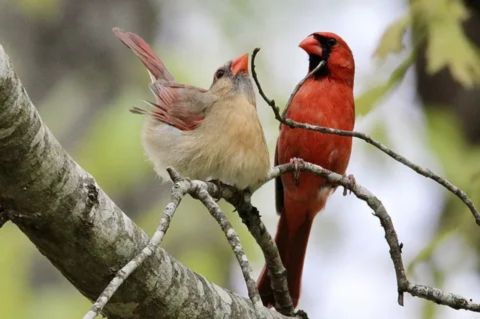
With their vibrant red feathers and cheerful songs, cardinals are among the most adored birds in North America. But there’s a lot more to these striking creatures than meets the eye. From their love lives to their surprising habits, these feathered beauties have some incredible secrets. Here are fun and fascinating facts about cardinals that will make you appreciate them even more!
Did You Know Cardinals?? Quick Facts About Cardinals
| Features | Details |
|---|---|
| Common Name | Northern Cardinal |
| Scientific Name | Cardinalis cardinalis |
| Family | Cardinalidae |
| Average Length | 8–9 inches (20–23 cm) |
| Wingspan | 10–12 inches (25–30 cm) |
| Weight | 1.5–1.7 ounces (42–48 g) |
| Lifespan (in the wild) | 3–5 years (can live up to 15 years) |
| Color (Male) | Bright red with a black face mask |
| Color (Female) | Brownish-tan with hints of red |
| Habitat | Woodlands, gardens, shrublands, and backyards |
| Diet | Seeds, grains, fruits, and insects |
| Song / Call | “Cheer, cheer, cheer” or “Birdie, birdie, birdie” |
| Nesting Season | March to August |
15 Interesting Facts About Cardinals
The Northern Cardinal is one of North America’s most beloved and easily recognizable songbirds. From their striking colors to their sweet songs, here are 15 unique and attention-grabbing facts about these feathered wonders:
1. They’re Named After Catholic Cardinals
Ever wondered how they got their name? The Northern Cardinal was named after Catholic cardinals, whose red robes resemble the male bird’s feathers. It’s a perfect fit, considering both exude elegance and importance.

2. Cardinals Wear Their Color Proudly
The bright red plumage of the male cardinal isn’t just for show—it’s a badge of health and vitality. The more vivid the red, the healthier the bird. That fiery color comes from carotenoid pigments found in their diet, mainly from seeds and berries. Females, on the other hand, have soft tan or brown feathers with a touch of red—elegant in their own subtle way.
3. Both Male and Female Sing—A Rare Trait!
Unlike most songbirds, female cardinals sing too! In fact, their songs are often more complex than the males’. They use their voices to communicate with their partners, often while sitting on their nests—almost like they’re chatting across the forest.
4. Cardinals Are Monogamous (Mostly)
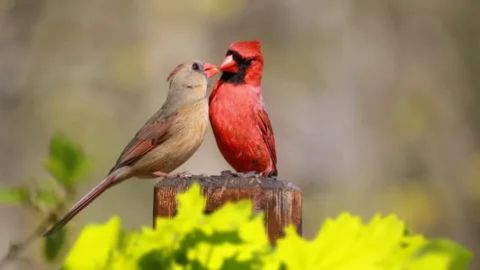
Cardinals are known for forming strong pair bonds. Once they find a mate, they often stick together for life. They can be seen feeding each other, especially during courtship season—a sweet act that looks like a tiny bird kiss!
Forget “flock”—a group of Northern Cardinals can be charmingly referred to as a “college,” “conclave,” or even a “Vatican”—a nod back to their namesake.
5. A Genetic Rarity: The Yellow Cardinal
Hold onto your binoculars! In an estimated one in a million birds, a genetic mutation can prevent the conversion of yellow pigments from food into red. The result? A stunning, once-in-a-lifetime sighting of a Northern Cardinal in a beautiful orangish-yellow hue!

6. They’re Year-Round Residents
While many birds migrate to warmer places in winter, cardinals are homebodies. They stay put all year long, even during snowy months. Their bright red feathers against white snow create one of the most beautiful winter sights in nature.
7. Dad Does the Babysitting
Cardinals typically raise two to four broods each year! After the first set of eggs hatches, the male takes on the job of feeding and caring for the newly fledged young while the female begins incubating the next clutch of eggs.
Cardinals can see ultraviolet light, allowing them to spot food and mates in ways humans can’t.
8. Feeding the Fiancee
During courtship, the male performs a charming ritual: he feeds the female seed, beak-to-beak, as a way to strengthen their bond and show he’ll be a good provider.
9. A Weird Case of “Baldness”
Don’t be alarmed by a “punk-rock” look! Cardinals can sometimes lose all their head feathers at once during their late summer molt. They aren’t sick; they’re just temporarily bald until new feathers grow in.
10. They Use Ants as Soap!
A strange but true behavior called “anting” involves the cardinal voluntarily covering its body with ants. The ants release formic acid, which is thought to act as a natural pesticide, helping the bird get rid of bothersome parasites like lice.
11. The Crest Is a Mood Ring!
That distinctive, pointy crest isn’t just for looks—it’s an emotional indicator! When the cardinal is calm and relaxed, its crest feathers are flat against its head. When it’s agitated, alert, or aggressive (like when defending its territory), the crest shoots straight up, acting like a tiny, feathered billboard of its current mood!
Their beaks contain powerful jaw muscles, strong enough to crack even the toughest seeds with ease.
12. Divorce is an option!
While it’s widely believed that cardinals mate for life, they aren’t absolutely tied down. Research indicates that a small percentage of mated pairs (around 20%) will split up after a breeding season. A female might “divorce” a male if he wasn’t a good provider or failed to defend their territory adequately.
13. Cardinals Inspire Sports Teams and States
The cardinal’s popularity goes far beyond backyards. It’s the official state bird of seven U.S. states—including Illinois, Indiana, Kentucky, North Carolina, Ohio, Virginia, and West Virginia. Plus, it lends its name to the St. Louis Cardinals baseball team and the Arizona Cardinals football team.

14. A Silent Signal for Danger
In addition to their loud, cheery whistles, cardinals have a specific call known as a “chip” note. This sharp, metallic sound is not just a general communication; it is a universal alarm call used to warn their mate and offspring about nearby dangers like a hawk or a lurking house cat.
15. A Spiritual Messenger in Folklore
Beyond scientific facts, the cardinal holds a powerful place in popular culture. In much of North American folklore, seeing a cardinal is believed to be a spiritual messenger or a “visitor from heaven,” a reminder that a loved one who has passed away is watching over you. They symbolize hope, joy, and spiritual vitality.
FAQs
1. What does it mean when you see a cardinal?
Many people believe seeing a cardinal is a spiritual sign. It’s often said that “when cardinals appear, angels are near.” For some, spotting one symbolizes that a loved one who has passed away is watching over them.
2. Why do cardinals attack windows or mirrors?
Male cardinals are highly territorial. When they see their reflection, they often mistake it for another bird invading their territory and will try to chase it away. It’s a natural instinct to protect their space.
3. What do cardinals eat?
Cardinals love seeds, fruits, and insects. Their favorite snacks include sunflower seeds, berries, and grains. In the summer, they also enjoy eating insects like beetles and caterpillars to get extra protein.

Curious by nature, storyteller by choice. I run Interesting Facts to bring you mind-blowing stories, hidden truths, and fascinating insights from around the globe. If it makes you say “Wow, I never knew that!”—my job is done.
Laiba Hanif is a professional fact-finder and the writer behind “Interesting Facts.” Fueled by a degree in Anthropology and over five years of experience unearthing hidden truths, she specializes in digging up the most bizarre, fascinating, and mind-bending tidbits the world has to offer. She’s here to prove that reality is stranger—and more amazing—than fiction.